Once a watch crosses $10,000, the rules should change. Sapphire crystal, 100 meters of water resistance and a respectable automatic movement are no longer enough. A watch costing $15,000 should offer something materially difficult to reproduce for $5,000.
That might mean an unusual escapement, exceptional hand finishing, a genuinely sophisticated complication, extreme movement engineering or proprietary construction — or an ownership proposition so strong that the economics themselves become part of the value. For this ranking, value is weighted roughly as follows:
- Movement / engineering: 25%
- Finishing: 20%
- Specifications / usability: 20%
- Brand / service infrastructure: 15%
- Actual purchase price versus underlying watch: 20%
These are watches that can realistically be purchased new between $10,000 and $20,000, including reputable discounted and gray-market pricing where appropriate. The question is simple: if you have $10,000–$20,000 to spend, which watches give you the most actual watch for the money? Here are the ten.
Prices were checked in September 2026 and may not include sales tax, import duties or optional configurations.
10. H. Moser & Cie. Pioneer Centre Seconds 40

Realistic price: ~$14,000–$17,500 · Value Score: 8.8/10
The first watch on the list comes from one of the smallest and most interesting independent Swiss manufactures. Inside the Pioneer is Moser’s HMC 200 automatic manufacture movement. You get:
- 72-hour power reserve
- In-house automatic movement
- Sapphire display back
- High-end movement decoration
- 40mm case
- 120m water resistance
- Luminous dial
- Genuine sports-watch construction
That last part matters. Independent haute horlogerie frequently comes wrapped in fragile dress watches with little water resistance. The Pioneer is different — you can actually wear it. It gives you small-production independent watchmaking without requiring small-production-independent-watch behavior.
Why it isn’t higher: at more than $15,000, it remains fundamentally a three-hand watch. The movement is beautiful and the brand is fascinating, but some watches ahead of it provide considerably more visible engineering or complication for similar money. Still, entering H. Moser territory for around $15K is a legitimate value proposition.
9. Chopard Alpine Eagle 41

Realistic price: ~$13,000–$17,000 · Value Score: 8.9/10
The Alpine Eagle is routinely underestimated because many buyers still think of Chopard primarily as a jewelry company. That ignores how much genuine watchmaking capability Chopard has built. The Alpine Eagle uses Chopard’s own 01.01-C manufacture movement and gives you:
- COSC chronometer certification
- 60-hour power reserve
- 4Hz frequency
- 100m water resistance
- Screw-down crown
- Sapphire display back
- Integrated bracelet
- Proprietary Lucent Steel construction
And it manages all of this in a case only about 9.7mm thick. The case and bracelet finishing are considerably more sophisticated than the typical luxury sports watch, and the dial is distinctive rather than another generic stamped texture.
The problem: depreciation. Buying an Alpine Eagle at full retail substantially weakens the value equation. Buying one new around $13,000–$14,000 changes it completely — at that price you are getting a thin, beautifully finished, fully in-house integrated sports watch for materially less than many comparable alternatives.
8. Jaeger-LeCoultre Reverso Tribute Duoface Small Seconds

Realistic price: ~$15,200 · Value Score: 9.0/10
The Reverso earns its place because nothing else on this list really does what it does. One side provides hours, minutes, small seconds and a traditional Reverso dial. Flip the case over and the second face provides a second time zone, 24-hour / day-night indication and an entirely different dial design.
Everything is powered by JLC’s shaped, hand-wound Calibre 854. That matters: this isn’t a round movement stuffed into a rectangular case — the movement was designed around the architecture of the watch. And the famous reversing case itself is a genuine mechanical construction comprising dozens of components.
What you’re really buying: two dials, two time zones, a shaped manufacture movement and one of the most recognizable mechanical case designs ever created. That makes $15,000 considerably easier to explain.
Weaknesses: approximately 42-hour power reserve, around 30m water resistance and limited sports-watch versatility. This is not the most practical watch here — but it may be the most mechanically distinctive.
7. Rolex Submariner 124060
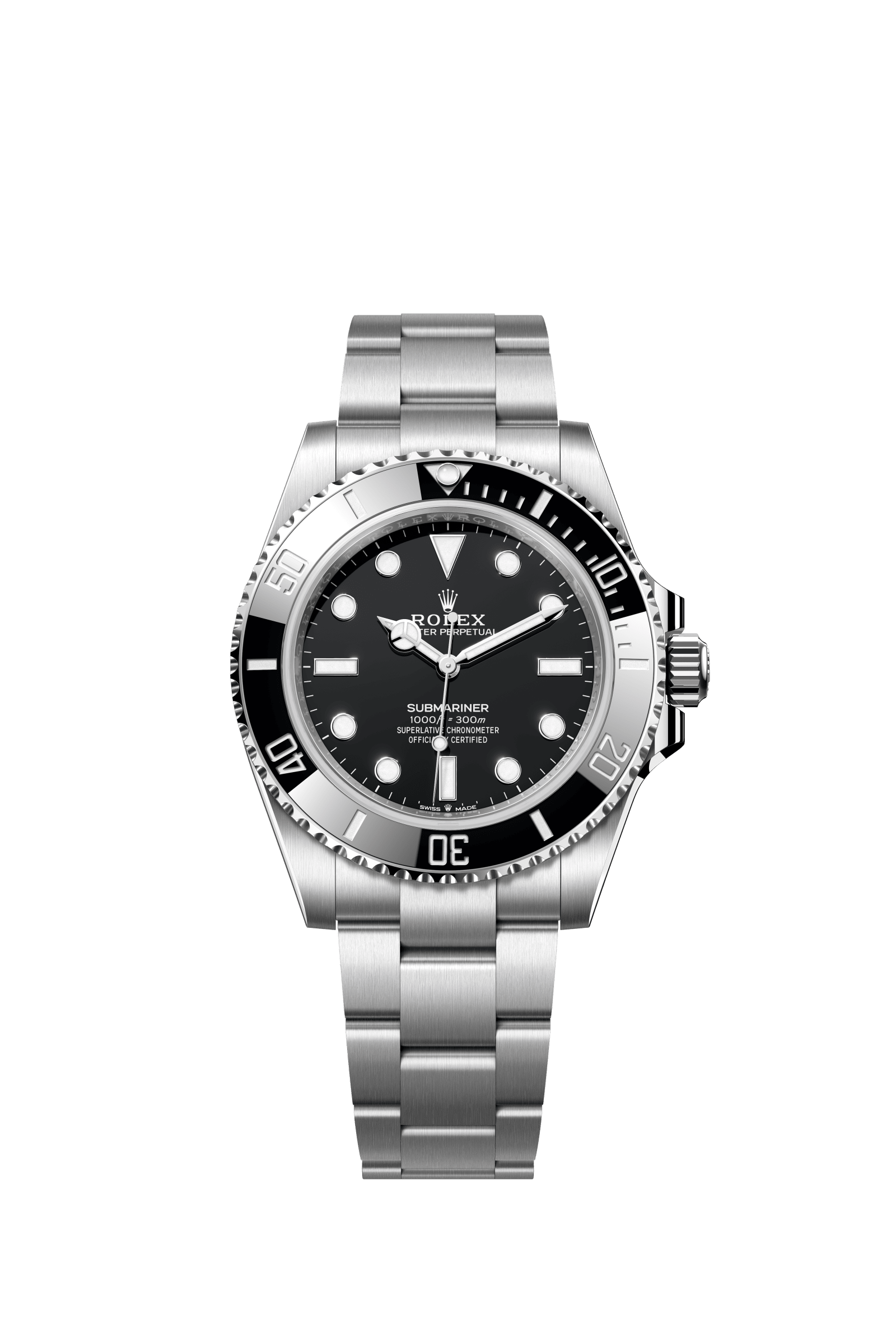
Realistic price: ~$13,000–$15,000 (retail ~$10,050) · Value Score: 9.1/10
This is where Rolex finally enters one of these rankings — not because the Submariner has the most sophisticated movement (it doesn’t), and not because it has the best finishing (it doesn’t). The Submariner earns its position because value isn’t limited to complication count. You get:
- Rolex Calibre 3230
- Approximately 70-hour reserve
- -2/+2 seconds-per-day specification
- Parachrom hairspring
- Paraflex shock protection
- Cerachrom ceramic bezel
- 300m water resistance
- Triplock screw-down crown
- Outstanding Oyster bracelet
- Excellent Glidelock adjustment
But then add something almost nobody else can match: service infrastructure, reliability, resale, liquidity and long-term desirability. Those things have monetary value. A Submariner is one of the easiest expensive watches in the world to own.
The catch: at $10,050 retail the value proposition is extremely strong. At $14,000+ secondary-market pricing, considerably less so. That’s why it stops at #7.
6. Blancpain Fifty Fathoms Automatique 42.3
Realistic price: ~$14,900–$17,000 · Value Score: 9.2/10
If Rolex wins the ownership argument, Blancpain wins the mechanical dive-watch argument. Inside the modern 42.3mm Fifty Fathoms is Blancpain’s Calibre 1315. You get:
- Automatic manufacture movement
- Three-barrel architecture
- 120-hour / five-day power reserve
- Silicon balance spring
- 4Hz frequency
- 300m water resistance
- Sapphire display back
- Date
That is serious movement hardware. The move to a 42.3mm case is also significant: the traditional 45mm Fifty Fathoms could be difficult to wear, and this version keeps the identity of the watch while becoming substantially more practical. Unlike many luxury divers, Blancpain has a legitimate historical connection to the development of the modern dive watch.
Why it isn’t higher: again, depreciation. At roughly $19,000–$20,000 retail the equation gets difficult. Around $15,000–$16,000 new, it becomes compelling.
5. Omega Speedmaster Calibre 321 “Ed White”

Realistic price: ~$17,000–$19,000 · Value Score: 9.3/10
This is not simply a more expensive Speedmaster Professional — it exists for a completely different reason. The centerpiece is Omega’s recreated Calibre 321, the movement architecture associated with some of the most important vintage Speedmasters ever produced. The 321 uses a traditional column-wheel chronograph architecture and is manufactured in far smaller numbers than the standard Moonwatch. Omega wraps it in an excellent ~39.7mm case, giving it more vintage-correct proportions than the standard 42mm Speedmaster Professional.
On paper, the value looks terrible. For nearly $20,000 you get:
- Manual winding
- Roughly 55-hour reserve
- 50m water resistance
- No date
- Steel construction
That spec sheet does not explain the price — but that isn’t the point. You’re paying for Calibre 321 architecture, specialized production, historical importance, excellent proportions, collector demand, relative scarcity and strong long-term desirability. This is collector value rather than specification value, and within that framework the Ed White makes considerably more sense than many watches costing similar money.
4. Jaeger-LeCoultre Master Control Calendar

Realistic price: ~$14,800–$17,500 · Value Score: 9.4/10
This is where the list starts getting mechanically serious. The Master Control Calendar gives you:
- Automatic manufacture movement
- Approximately 70-hour power reserve
- Day
- Date
- Month
- Moonphase
- Complete calendar functionality
- Sapphire display back
But the clever detail is the date mechanism. A traditional pointer-date hand would pass directly over the moonphase display at six o’clock; JLC solved that by making the date hand jump across the bottom portion of the dial between the 15th and 16th. It’s a small mechanical flourish that demonstrates what you’re actually paying for. And JLC packages everything into roughly 40mm × 10.95mm — a complete calendar with moonphase does not need to be a thick puck.
Weakness: only around 50m water resistance. But this isn’t trying to be a sports watch. If the question is “what does $15,000 worth of traditional Swiss watchmaking actually look like?”, this is one of the best answers.
3. Breguet Type 20 Chronographe 2057
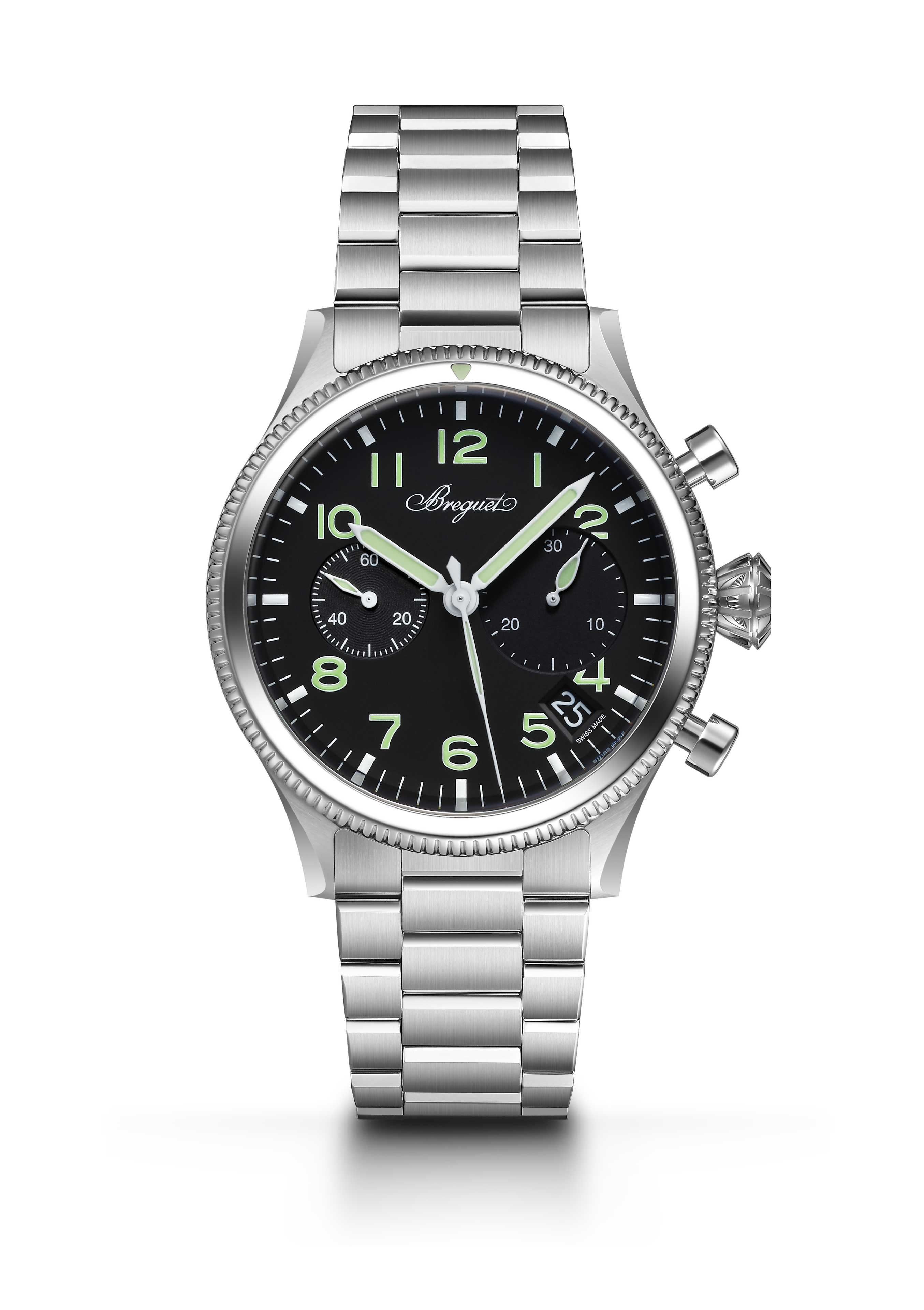
Realistic price: ~$15,500–$16,000 · Value Score: 9.5/10
This is where gray-market pricing creates a genuinely unusual opportunity. Retail pricing pushes the Breguet Type 20 above our $20,000 ceiling, but new examples can fall into the mid-$15K range — and at that price the watch becomes extremely difficult to ignore. Inside is Breguet’s Calibre 7281. You get:
- Automatic manufacture chronograph
- Flyback chronograph
- 36,000 vph / 5Hz frequency
- 60-hour reserve
- Silicon hairspring
- 339 components
- Sapphire display back
- 100m water resistance
- Traditional Breguet movement finishing
This is genuine high-end chronograph engineering — not simply a modular movement, not an externally sourced workhorse dressed up in an expensive case. The key word is Breguet: one of watchmaking’s historically important manufactures producing a modern 5Hz flyback chronograph with silicon technology, potentially around $15,500. That is an enormous amount of watchmaking.
Weakness: at roughly 42mm × 14mm it’s not particularly subtle, and buying Breguet at MSRP is financially painful. But discounted into the mid-teens, this becomes one of the most compelling chronograph purchases in the entire luxury market.
2. Grand Seiko SLGW003

Realistic price: ~$11,600 · Value Score: 9.6/10
This may be the purest movement-engineering proposition on the list. Grand Seiko’s 9SA4 is not another evolution of a traditional Swiss-style automatic — it represents a major rethink of the mechanical movement. You get:
- Manual winding
- 36,000 vph / 5Hz
- Grand Seiko Dual Impulse Escapement
- Free-sprung balance
- Overcoil hairspring
- Twin barrels
- 80-hour power reserve
- Power-reserve indication on the movement side
That 80-hour reserve is particularly impressive considering the movement operates at 5Hz; high-frequency movements normally consume more energy, and Grand Seiko managed both. Then comes the external execution:
- 38.6mm case
- Less than 10mm thick
- Brilliant Hard Titanium
- White Birch dial
- Extremely sharp hand and index finishing
- High-level movement decoration
At $11,600, this isn’t just competitive within the $10K–$20K category — it makes some watches costing $20K–$30K look uncomfortable.
The glaring weakness: water resistance. This is essentially a dress watch, which prevents it from becoming the overall winner. But if this ranking were based solely on movement engineering plus finishing divided by price, the Grand Seiko might be #1.
1. Bvlgari Octo Finissimo Automatic Steel

Realistic price: ~$11,000–$14,000 (retail ~$14,100) · Value Score: 9.7/10
The winner isn’t the watch with the most complications. It isn’t the watch with the strongest resale. And it isn’t the most famous brand here. The Octo Finissimo wins because it delivers something genuinely difficult to reproduce at almost any price.
Inside is Bvlgari’s BVL 138 automatic manufacture movement. Movement thickness: 2.23mm. Not the watch — the entire automatic mechanical movement. Inside that 2.23mm architecture Bvlgari fits:
- Automatic winding
- Platinum micro-rotor
- Approximately 60-hour power reserve
- Full movement decoration
- Sapphire display-back presentation
Then the entire watch measures approximately 6.4mm thick — thinner than many watch movements by themselves. But here’s what makes the steel Octo Finissimo particularly impressive: it’s not merely an ultra-thin dress watch. It has 100 meters of water resistance and a screw-down crown. That combination is extraordinarily difficult: ultra-thin watches generally sacrifice rigidity, water resistance or everyday durability, and Bvlgari engineered around those compromises — then added one of the most distinctive case designs in modern watchmaking.
This is what $10,000+ should buy. Not merely nicer finishing. Not merely a more famous logo. Something genuinely difficult to make. At roughly $11,000–$14,000 new, the Octo Finissimo gives you legitimate ultra-thin haute horlogerie movement engineering in an everyday sports watch. That’s why it takes #1.
| Rank | Watch | Realistic New Price | Value Score | Core Argument |
|---|---|---|---|---|
| 1 | Bvlgari Octo Finissimo Automatic Steel | $11,000–14,000 | 9.7/10 | 2.23mm auto micro-rotor movement, 6.4mm case, 100m + screw-down crown |
| 2 | Grand Seiko SLGW003 | ~$11,600 | 9.6/10 | 9SA4 Dual Impulse Escapement, 5Hz, 80h manual, hi-Ti |
| 3 | Breguet Type 20 Chronographe 2057 | $15,500–16,000 | 9.5/10 | 5Hz flyback manufacture chronograph, silicon, 100m |
| 4 | JLC Master Control Calendar | $14,800–17,500 | 9.4/10 | Complete calendar + moonphase, jumping date, ~70h, slim |
| 5 | Omega Speedmaster Calibre 321 “Ed White” | $17,000–19,000 | 9.3/10 | Recreated column-wheel 321, 39.7mm, collector value |
| 6 | Blancpain Fifty Fathoms Automatique 42.3 | $14,900–17,000 | 9.2/10 | Calibre 1315, five-day / three-barrel, silicon, 300m |
| 7 | Rolex Submariner 124060 | $13,000–15,000 | 9.1/10 | 3230, 70h, ceramic, 300m + unmatched ownership/liquidity |
| 8 | JLC Reverso Tribute Duoface | ~$15,200 | 9.0/10 | Two dials, dual time, shaped hand-wound Calibre 854 |
| 9 | Chopard Alpine Eagle 41 | $13,000–17,000 | 8.9/10 | In-house 01.01-C, COSC, 9.7mm, Lucent Steel, integrated |
| 10 | H. Moser Pioneer Centre Seconds 40 | $14,000–17,500 | 8.8/10 | HMC 200 manufacture auto, 72h, 120m independent sports watch |
Category Winners
Best Overall Value — Bvlgari Octo Finissimo Automatic
Ultra-thin micro-rotor engineering combined with real sports-watch usability.
Best Movement Engineering — Grand Seiko SLGW003
The 9SA4 is one of the most technically ambitious conventional mechanical movements available anywhere near $10,000.
Best Chronograph — Breguet Type 20 2057
5Hz, flyback, silicon technology and manufacture construction.
Best Complication Value — Jaeger-LeCoultre Master Control Calendar
A complete calendar and moonphase with genuinely clever mechanical execution.
Best Dive Watch — Blancpain Fifty Fathoms 42.3
The Rolex wins ownership economics; the Blancpain wins movement hardware.
Best Ownership Proposition — Rolex Submariner 124060
Nothing else combines durability, liquidity, resale, servicing and recognition quite as effectively.
Best Collector Watch — Omega Speedmaster Calibre 321
Recreated column-wheel architecture, specialized production and strong long-term desirability.
Best Iconic Design — Jaeger-LeCoultre Reverso Tribute Duoface
Two faces, a shaped manufacture movement and one of the most recognizable cases ever made.
Best Integrated Sports Watch — Chopard Alpine Eagle 41
A thin, beautifully finished in-house integrated bracelet watch that is badly underrated.
Best Independent — H. Moser Pioneer Centre Seconds 40
Small-production independent watchmaking you can actually wear every day.
Five That Just Missed
Girard-Perregaux Laureato 42
One of the legitimate historic integrated-sports-watch designs, with the in-house GP01800, excellent finishing and 100m water resistance. At roughly $13K–$15K new it’s very good — it narrowly loses to the Alpine Eagle and Moser on overall value.
IWC Ingenieur Automatic 40
An excellent 40mm Genta-derived sports watch with the 120-hour IWC 32111 and 100m water resistance. But around $13,000, the simple three-hand/date architecture and closed caseback make the value proposition difficult against this competition.
Piaget Polo Date
Thin, attractive and powered by Piaget’s manufacture 1110P. Discounted pricing around $12K–$13K is interesting, but it simply doesn’t provide enough movement differentiation to enter the ten.
Vacheron Constantin Fiftysix Self-Winding
One of the cheapest ways into Vacheron Constantin — which is also the problem. The base Fiftysix provides relatively modest water resistance and movement specifications compared with what else $12K+ can buy; a lot of the purchase price is paying for the words “Vacheron Constantin.”
Glashütte Original PanoMaticLunar
The painful omission. It offers a manufacture movement, Panorama Date, moonphase, three-quarter plate, hand-engraved balance bridge, duplex swan-neck adjustment and a 21k gold rotor — and new-market pricing can hover around the $10,000 boundary. Strictly speaking that puts it partly into the $5K–$10K category; if the floor were loosened slightly, it could easily rank in the top five here.
Overall Ranking
- Bvlgari Octo Finissimo Automatic Steel — 9.7/10
- Grand Seiko SLGW003 — 9.6/10
- Breguet Type 20 Chronographe 2057 — 9.5/10
- Jaeger-LeCoultre Master Control Calendar — 9.4/10
- Omega Speedmaster Calibre 321 “Ed White” — 9.3/10
- Blancpain Fifty Fathoms Automatique 42.3 — 9.2/10
- Rolex Submariner 124060 — 9.1/10
- Jaeger-LeCoultre Reverso Tribute Duoface — 9.0/10
- Chopard Alpine Eagle 41 — 8.9/10
- H. Moser Pioneer Centre Seconds 40 — 8.8/10
What Changes Above $10,000?
This is the price range where a famous name should stop being enough. Below $5K, a well-built Swiss automatic with excellent specifications can represent genuine value. Between $5K and $10K, manufacture movements, METAS certification, Spring Drive and sophisticated chronographs start appearing. Above $10,000, the watch should explain where the money went.
That could mean a 2.23mm micro-rotor movement, a proprietary Dual Impulse Escapement, a 5Hz flyback chronograph, a complete calendar with a jumping date hand, a reversible two-face dual-time movement or a five-day high-end dive-watch caliber. If the answer is simply “it’s steel, automatic and the brand is prestigious,” that’s no longer enough.
The best watches in this price range aren’t merely more expensive. They do something the cheaper watches can’t.